
Tioga County Deed Records by Instrument Type
Every Tioga County deed record sits in the County Clerk's index, alongside the instruments that give a conveyance its full meaning. A deed is the natural starting point. Read past the label, though. The category and the legal description tell you what actually changed hands, and related filings can alter that story.
| Instrument | What it may record | What to compare |
|---|---|---|
| Deed | A conveyance from grantor to grantee | Date, parties, consideration, legal description |
| Quitclaim deed | Transfer of the grantor's interest without broad warranty | Interest conveyed and surrounding chain |
| Easement | A right affecting use or access | Servient land, benefited party, map |
| Mortgage | Recorded security interest | Borrower, lender, property, later release |
| Assignment or discharge | Transfer or release of an encumbrance | Reference to the earlier instrument |
| Map or survey | Filed subdivision or surveyed description | Map number, lots, seals, deed references |
Search the Tioga County Grantor and Grantee Trail
Pull the owner name from Beacon first. Run that exact name as grantee in the Clerk's grantor-grantee index. The goal is to find the acquisition deed. Open the newest plausible result. Compare its municipality, legal description, parties, and recording date against your subject parcel. The grantor on that deed becomes your next search name. Walk the chain backward one link at a time. Spelling variants, marriages, trusts, estates, or entities can muddy the index. Search in both directions until the trail holds together.
- Write down the current assessment name and all parcel keys.
- Search the name under deeds as a grantee.
- Match the legal description to the parcel rather than relying on address alone.
- Record instrument number or book/page and the grantor.
- Repeat under that grantor to extend the chain.
Online Tioga County Deed Records Begin in 1970
The Clerk's certified-date sheet places online deeds from August 24, 1970. Online mortgages start from March 12, 1970. Many other categories, including several lien indexes, only begin September 1 or September 8, 2003. Those are online coverage limits, not proof that older paper records never existed.
Guests can browse the index, but images demand an account or subscription. Daily access costs $5, and printing runs $0.65 per page. The Clerk eSearch source displays the login and search options.
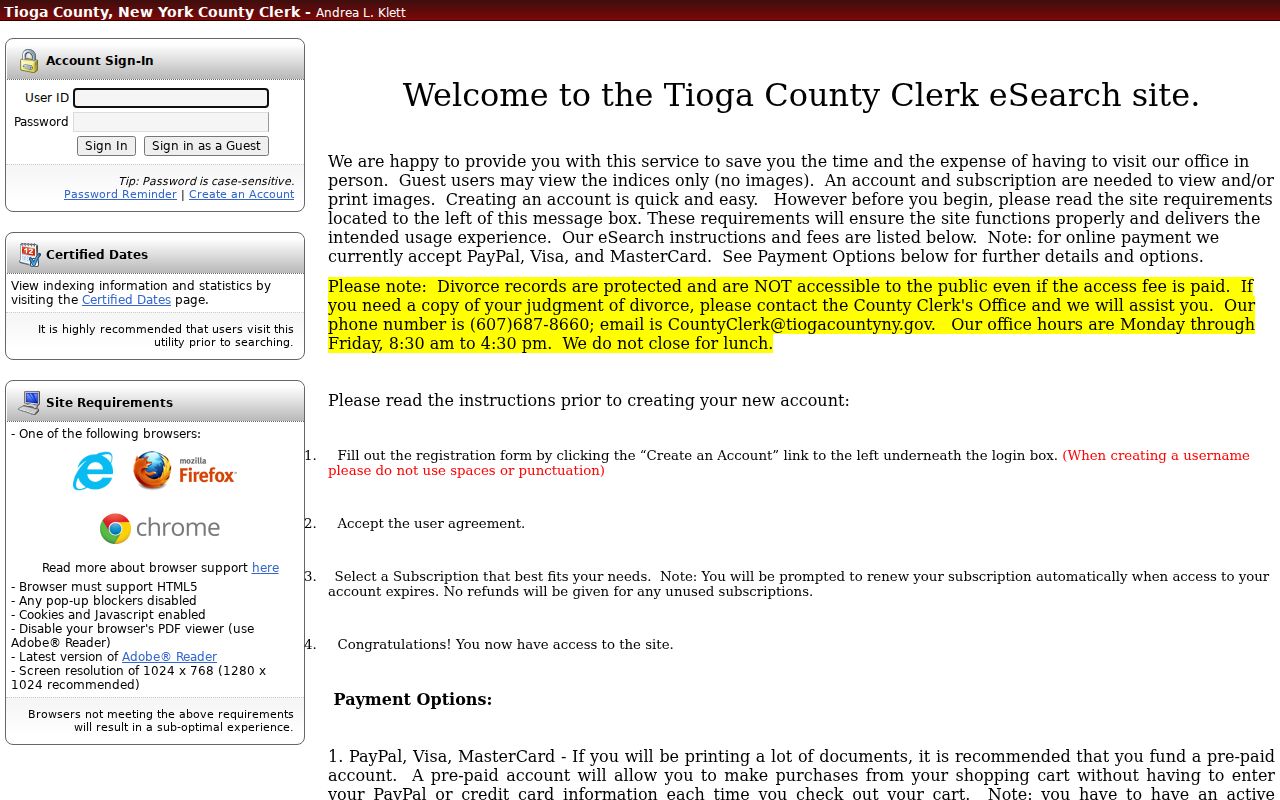
The page itself shows why an index entry and a recorded image count as two separate tasks in Tioga County.
Request a Tioga County Deed Copy from the Clerk
An image may be unavailable. The date may fall before online coverage, or an official copy may be required. In those cases the Clerk counter and the published county page are the fallbacks. Include the party names, the document category, the approximate recording date, the parcel municipality, and the legal description or PIN. Add the index reference when it is known. Say whether a plain or certified copy is needed.
The official Clerk page publishes office hours, recording and copy charges, eRecording partners, and forms. Recording closes at 4:15 p.m., while office hours are listed through 4:30 p.m. Review the County Clerk source before mailing or visiting.
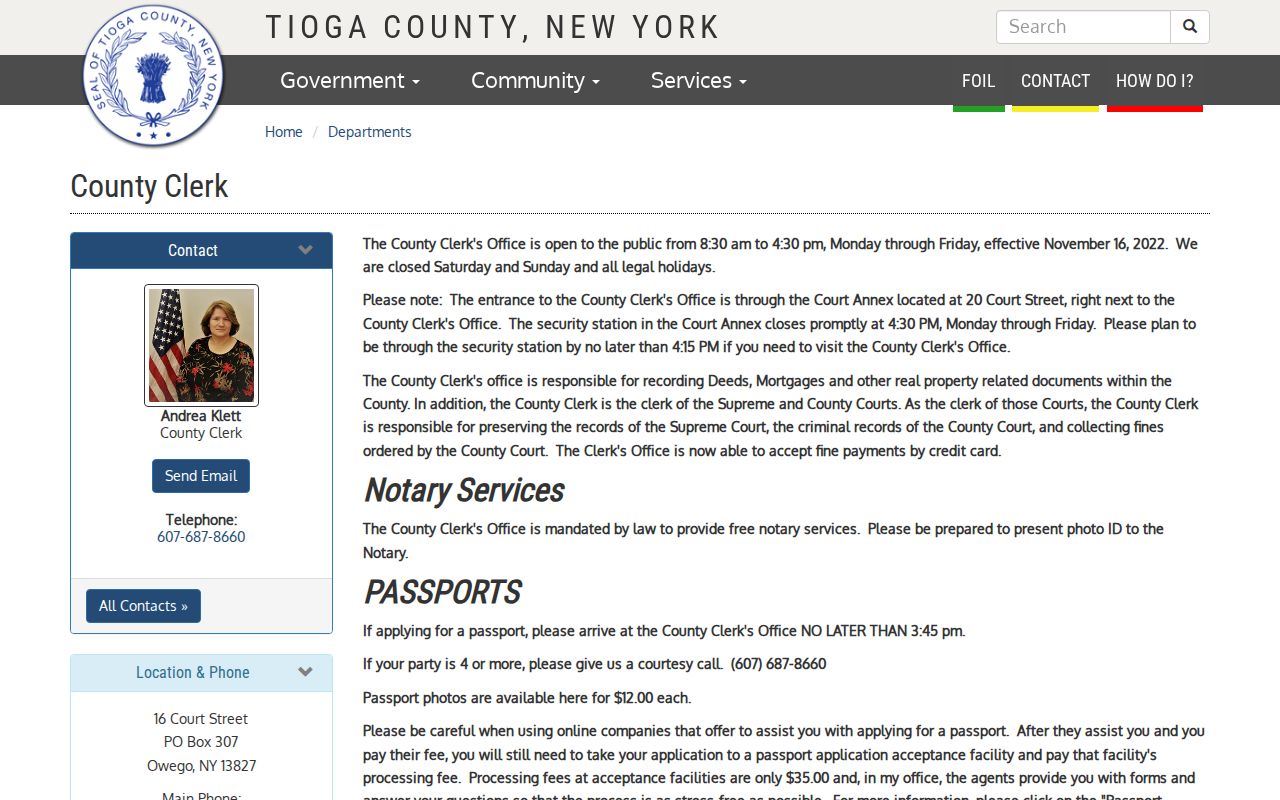
Check the fee section on the Clerk's page again when preparing a request. Charges and procedures can change without much notice.
Read Liens and Releases with Tioga County Deeds
A deed alone never proves that recorded claims were released. Search mortgages, assignments, discharges, judgments, liens, and lis pendens under every relevant party. Tie each discharge back to its original mortgage reference. A filed claim is not the same thing as a final court outcome. The Clerk index shows what was recorded, nothing more. It is not an opinion that every encumbrance has surfaced.
The Clerk page lists a $60 lis pendens fee effective April 1, 2024. Court fights may also lead to New York eCourts, NYSCEF, the local Supreme and County Court file, or the Northern District of New York for federal matters. Confirm any result with the court or clerk holding the actual file.
Legal Descriptions Keep a Tioga Chain on Track
Street addresses change, and postal cities often disagree with town lines. Anchor the chain in the deed's own language instead. Metes-and-bounds calls, lot and block numbers, filed-map references, adjoining owners, and the municipality together confirm a chain. They show that successive instruments concern the same land. Cross-check those details against the PIN, current print key, SBL, acreage, and GIS location. Remember that parcel polygons are tax-reference geometry, not boundary law.
Splits and mergers explain many mismatches between an old deed and a current parcel. A parent tract may now carry several PINs. A single parcel may combine earlier lots. Follow the map references whenever a chain crosses a subdivision. Ask the Clerk for the recorded map then.
Maps and Surveys Remain Physical Recording Records
Tioga County's published procedure demands two paper maps for any map or survey recording. Each map must bear an original seal or wet signature. A GIS screenshot fails that rule. It cannot substitute for the filed item. Use the county viewer to locate the parcel. Then lean on the deed and the recorded map to understand the legal layout.
The distinction matters most for easements, access strips, subdivision lots, and neighbor disputes. A line on the county map offers helpful orientation, not a surveyed boundary opinion. When exact placement controls a decision, get the filed document and consult a licensed surveyor.
Tioga County Has No Verified Fraud Alert Signup
The official Clerk, Treasurer, assessment, GIS, and county pages publish no property-fraud-alert enrollment. So treat any unverified service billing itself as a county alert with suspicion. Never submit names or payment details to one. Instead, monitor the Clerk's own index. Call the Clerk through the published county contact if a recording notice looks wrong.
Reading the instrument itself is the stronger safeguard. Check the grantor, grantee, acknowledgments, legal description, recording reference, and any linked mortgage or release. A sudden change in an assessment mailing address is reason to compare records. It is not proof of a fraudulent deed on its own.
Older Tioga County Deeds Need Local History Leads
Older deeds take detective work. Anything recorded before August 1970 sits in physical indexes and deed books. Ask the County Clerk directly. The Tioga Historical Society keeps more than 300,000 surname cards. It also holds family files, newspapers, diaries, and local histories. The County Historian and Coburn Free Library help too. So do New York State Library directories and newspaper runs, which bridge changed street addresses.
None of this transfers title. Use it only for leads. A spelling, a date range, an estate or business name, or a map clue can carry back to the Clerk or court record. Tioga County records tell of no courthouse fire or complete deed-book loss. So an apparent gap stays unresolved until the Clerk explains it.
Recorded is not guaranteed. Tioga County deed records show indexed instruments. They do not reveal every unrecorded interest or substitute for a professional title examination.
Write everything down. A complete deed note preserves the grantor, grantee, recording date, deed type, and consideration wording. It should also record the instrument or book and page number, the municipality, the legal description, acknowledgments, and references to prior deeds or maps. Cott-style screens suggest possible fields. Treat that list as a template only. Tioga County availability rests in the actual index. Record exactly what the county result displays, pull the image when a missing field affects the conclusion, and never fill an absent Tioga County field from an interface example.